
Working, Studying, and Complying During the COVID-19 Pandemic (First-Wave): Psychological and Demographic Predictors of Protective Behaviours in Australian Students and General Public
Background:
Behaviours such as social distancing are crucial in curbing transmission of COVID-19. This research sought to study individual and socio-cultural factors influencing behaviour change during the COVID-19 pandemic.
Protective behaviours were classified into the following:
(1) Avoidant Behaviours (e.g. social distancing)
(2) Management of Illness (e.g. seeking medical advice when exhibiting symptoms)
(3) Hygiene Behaviours (e.g. hand-washing)
We investigated the following psychological factors hypothesised to influence adoption of these behaviours:
- Big 5 Personality: Extraversion, Agreeableness, Conscientiousness, Neuroticism, Openness
- Political Orientation: Conservatism, Right-Wing Authoritarianism
- Resilience and Adaptability
- Psychological Reactance (i.e. tendency to experience motivation to regain freedoms that have been threatened)
- Beliefs about COVID-19: Response Efficacy Beliefs (i.e. protective behaviours are effective in reducing the spread of COVID-19), Perceived Benefits Beliefs (i.e. protective measures are beneficial and thus accepted), Perceived Barriers Beliefs (i.e. protective measures are inconvenient and costly)
- Worry about COVID-19
- Media Consumption: Sources used to get COVID-19 information (Official e.g. government websites, Informal e.g. word of mouth), frequency of checking source legitimacy
Participants and Design:
609 Australians completed an online survey consisting of COVID-19 measures (behaviours, beliefs and perceptions, worry, information consumption), and psychological constructs (personality, resilience/adaptability, reactance, political beliefs). Exploratory Factor Analyses were conducted on COVID-19 measures.
Structural Equation Models were conducted on three groups (working public, working students, non-working students), with psychological constructs predicting behavioural compliance. Mediating roles of COVID-19 worry and beliefs were tested.
Results:
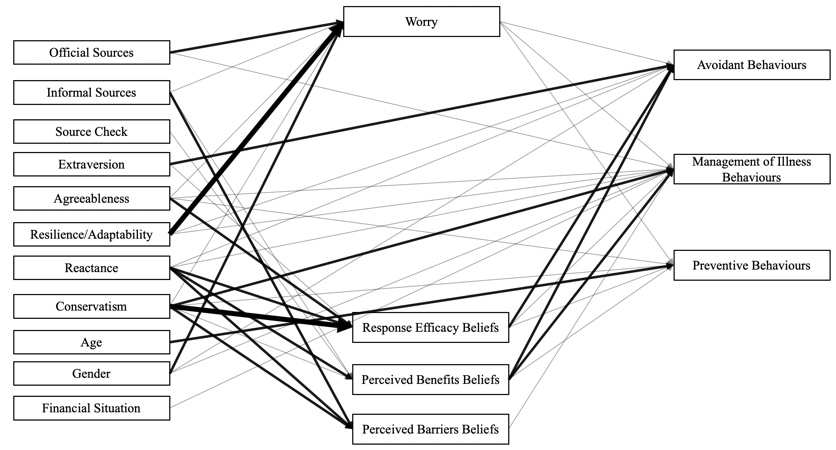
The above figure depicts statistically significant predictors.
A high-density line indicates the path was significant for all three-groups.
A medium-density line indicates significance for two groups.
A lower-density line indicates significance for one group.
Key Findings:
Overall, predictors of protective behaviours largely differed between groups depending on one’s life circumstances.
Adaptive beliefs, Extraversion, Conservatism, and Age were important predictors of protective behaviours.
- Adaptive health beliefs (response efficacy, perceived benefits) predicted avoidant behaviour
- Less extraverted people are more likely to adopt avoidant behaviours
- In the working public group, people who scored lower on Reactance were more likely to adopt avoidant behaviours
- Higher Conservatism and Perceived Benefits predicted management of illness behaviours in two groups
- Older people were more likely to adopt hygiene behaviours
- Worry about COVID-19 and Beliefs mediated several relationships between independent variables (Resilience/Adaptability, Conservatism, Reactance) and protective behaviours
Conclusions:
We identified ‘adaptive’ and ‘maladaptive’ psychological traits influencing adoption of protective behaviours, and illustrated the importance of the link between beliefs and behaviours.
Interventions and policies to increase positive behaviour change should be tailored to specific groups based on demographic and psychological factors.
There is also a need to increase public ability to identify and disregard misinformation about COVID-19 as the information we receive has a direct influence on our knowledge and beliefs which in turn shape our behaviour.