

Resilience, Adaptability, Readiness
Resilience, Adaptability, and Cognitive Readiness in the Face of COVID-19: Validating CF2 Constructs as Predictors of Lockdown Readiness and Mental Well-being
Background:
The COVID-19 pandemic presents an unprecedented and prolonged period of uncertainty, risk, and threat. The impact spans across various domains (health, economy, social life, well-being) and places a heavy burden on governments to respond with effective yet sustainable policies, as well as on the Australian public to adaptively respond to these measures.
The Cognitive Fitness Framework (CF2; Aidman, 2020, see Figure 1 below) offers a set of constructs underpinning performance in high-stakes contexts. These constructs are likely to drive better adjustment and recovery during prolonged, uncertain, and potentially high-risk situations, including COVID-19. In particular, this research focused on resilience, adaptability, and readiness.
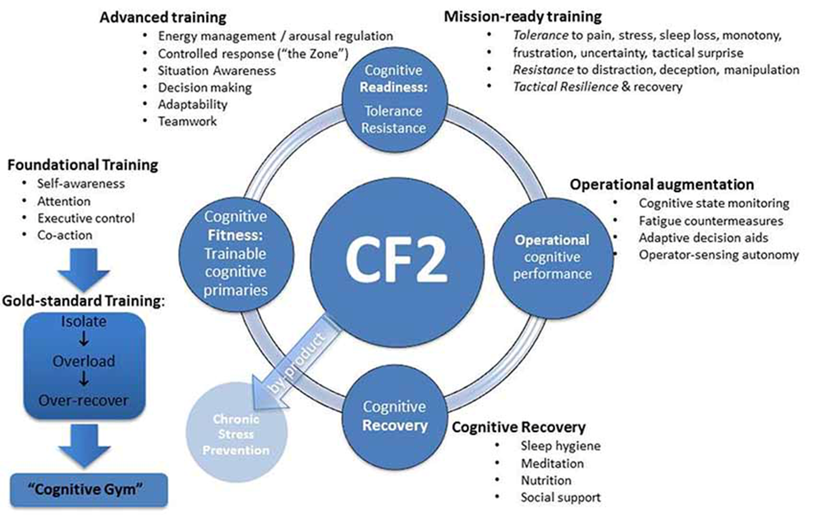
Figure 1. The Cognitive Fitness Framework (Aidman, 2020)
Cognitive readiness has been used in the military domain to capture “the mental preparation (including skills, knowledge, abilities, motivations, and personal dispositions) an individual needs to establish and sustain competent performance in the complex and unpredictable environment of modern military operations” (Morrison & Fletcher, 2002).
Keegan et al.’s (2020) Acute Readiness and Monitoring Scale is a self-report measure of readiness in the military domain as “an acute state of preparation and capability to perform any key task or role, in the immediate future.” It captures nine dimensions: overall readiness, physical readiness and fatigue, cognitive readiness and fatigue, threat-challenge/emotional readiness, skills and training, group/team readiness, and equipment readiness.
This research adapted the readiness construct to the COVID-19 context and developed a new easily accessible and administrable tool suitable for the civilian population. We extended Keegan et al.’s conceptualisation to include metacognitive and resilience aspects from other leading cognitive readiness models (e.g., Fletcher & Wind, 2014; Morrison & Fletcher, 2002).
Study Aims:
- Validate CF2 constructs (e.g., resilience, adaptability, cognitive readiness), utilising the unique opportunity created by COVID-19
- Determine the factors that facilitate positive and adaptive responses following the first wave and lockdown (future lockdown readiness and current mental well-being)
- Provide initial evidence for identifying and assessing cognitive attributes that can be targeted during periods of prolonged uncertainty, in preparation for future threats
Participants and Design:
The sample included 442 Australians (141 NSW, 126 Victoria, 175 other states). The mean age was 34.19 and 48% were female.
Participants completed a one-hour survey of traditional and newly developed measures.
A series of regressions were conducted predicting Future Lockdown Readiness (newly developed) and Current Mental Well-being using:
- Newly developed measures
- Pandemic Readiness Scale (overall readiness, physical readiness and fatigue, cognitive/mental readiness and fatigue, emotional readiness, household/family readiness, skills readiness, equipment readiness, metacognitive readiness
- Multidimensional Index of COVID-19 Worry (Personal/Family Concerns, Infrastructure/Supplies Concerns, Economic/Liberties Concerns, Personal Financial Concerns)
- COVID-19 Impact Index (Positive and Negative Impact)
- Cognitive fitness constructs
- Resilience
- Adaptability
- Impulsivity and Self-Control
- Cognitive Ability and Decision-Making
Whilst controlling for:
- Psychological constructs
- Reactance (tendency to experience motivation to regain threatened freedoms)
- Amorality
- Social Conservatism
- Hope
- Social Desirability
- Demographics
- Age and Gender
- Education and Income
- Household Size
- Financial Security
- Social Support
- Political Orientation
- Government Opinions
Results:
Analyses of the new Pandemic Readiness Scale revealed three dimensions.
- Personal/Household Readiness (e.g., “I have confidence in my household/family to overcome challenges related to COVID-19”)
- COVID-19 Fatigue (e.g., “My emotional health is fragile after enduring the COVID-19 pandemic experience”)
- COVID-19 Resilience/Growth (e.g., “I have a better understanding of how to adapt to challenging situations as a result of the pandemic”)
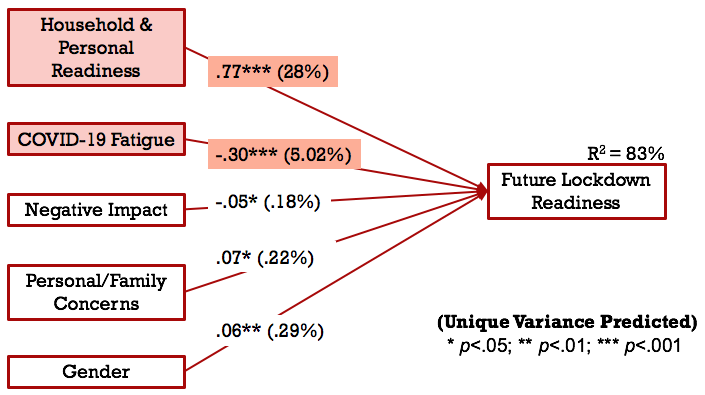
Significant Predictors of Future Lockdown Readiness (controlling for all other variables):
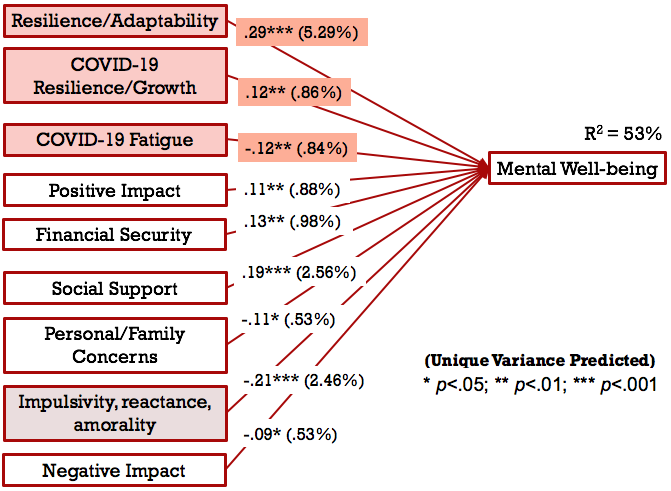
Significant Predictors of Mental Well-being (controlling for all other variables):
Key Take-Aways:
- Overall support for the importance of CF2 constructs (resilience, adaptability, readiness) during the prolonged period of uncertainty caused by COVID-19
- Pandemic Readiness (Household/Personal Readiness & Fatigue facets) play an important role in facilitating positive adaptation in response to the threat of future lockdowns
- Pandemic Readiness (Resilience/Growth & Fatigue facets) as well as Resilience and Adaptability and Impulsivity/Reactance/Amorality are important predictors of Mental Well-being following the first-wave of the pandemic, regardless of social support, financial security, positive and negative impacts of COVID-19, level of worry, and other key variables
- This research provided initial support for the validity and excellent psychometric properties of newly developed tools for assessing readiness for pandemics, pandemic impact, and worries in the general population
References
Aidman, E. (2020). Cognitive fitness framework: Towards assessing, training and augmenting individual-difference factors underpinning high-performance cognition. Frontiers in Human Neuroscience, 13(466). https://doi.org/10.3389/fnhum.2019.00466
Fletcher, J. D., Wind, A. P. (2014). The evolving definition of cognitive readiness for military operations. In O’Neil, H. F., Perez, R. S., Baker, E. L. (Eds.), Teaching and measuring cognitive readiness (pp. 24–52). New York, NY: Springer.
Keegan, R. J., Flood, A., Niyonsenga, T., Welvaert, M., Rattray, B., Sarkar, M., Melberzs, L., & Crone, D. (2020). Developing psychometric measures of resilient performance capability: Acute Readiness and Army Resilience Traits Scales. First Training Enhancement and Military PERformance (TEMPER) Symposium, 14th February 2020, UNSW Canberra.
Morrison, J. E., Fletcher, J. D. (2002). Cognitive readiness (P-3735). Alexandria, VA: Institute for Defense Analyses.